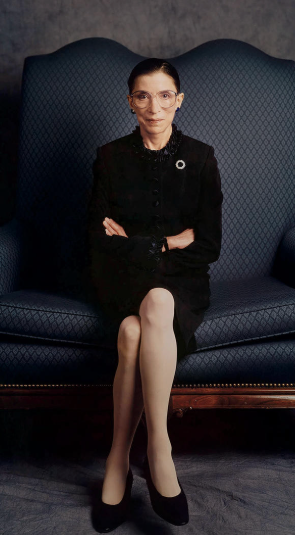
Ruth Bader Ginsburg
Ruth Bader Ginsburg was born in Brooklyn, New York, on March 15, 1933, and she would become one of the most well-known and influential Supreme Court Justices in United States history. In the following paragraphs, you will discover how she became such an important role model for the citizens of the United States.
Ruth began her journey to the Supreme Court as a law student. From the start of her career, Ruth faced discrimination for being a woman. She accomplished the great achievement of being accepted into Harvard Law School as one of nine women out of five hundred students. From this early point in her career, Ruth Bader Ginsburg had already begun to pave the path for women and others who wanted to accomplish things that many thought were impossible. During her time at Harvard, Ruth and some of her female peers were prohibited from accessing one of the libraries at the school. Even though throughout her entire life Ruth faced gender discrimination, she continued to follow her dreams and became the second woman and first Jewish person to serve on the U.S. Supreme Court and fought for equality for the rest of her life.
During the time that Ruth Bader Ginsburg was in law school, it was very common for women to be expected not to hold a job, but rather to work inside their homes, while the men worked to sustain a family. Because of this, after Ruth graduated from Columbia Law School (after transferring from Harvard) with incredible grades, no one would offer her a job. With no opportunities to become a lawyer, Ruth Bader Ginsburg became a professor at Rutgers University. During her time at Rutgers, she learned that mothers with careers were not given health insurance by their employers, but their male employees were. Ruth also discovered that she was being paid less than her male coworkers. This was the beginning of her drive for equality. She informed the university of her concerns, requesting that everyone be paid equally and she was successful.
She continued to advocate in circumstances where gender equality was not being prioritized, taking on a legal role at the American Civil Liberties Union (ACLU). An example of a case Ruth Bader Ginsburg argued for equality was her first case for the ACLU in front of the Supreme Court, where she argued for equal benefits for military spouses. Here, she famously quoted: “I ask no favor for my sex. All I ask of our brethren is that they take their feet off our necks.” Another example of one of Ruth’s cases involving gender equality was Duren v. Missouri, which challenged a law that excluded women from jury service after they had asked to serve.
She proceeded to win so many cases that in 1980, President Jimmy Carter appointed her to the U.S. Court of Appeals, and in 1993, President Bill Clinton appointed her to the U.S. Supreme Court.
For the rest of her career, Ruth Bader Ginsburg stood for people of all genders and races. She continued to disagree with statements she did not agree with so frequently that she earned herself the nickname “Great Dissenter.”
Ruth Bader Ginsburg has left a great legacy behind for all people. She paved the road for women to follow their dreams and proved to the world that it does not matter what your gender or your skin color is. Even after her death in 2020, Ruth Bader Ginsburg continues to be a symbol of feminism and will forever be remembered as an advocate for all people.
“Fight for the things that you care about. But do it in a way that will lead others to join you.”